


Get a 2nd opinion!
Nobody has a monopoly on income taxes. Certainly not when it comes to the Internal Revenue Code.
I recommend you get a 2nd opinion. Call 800-705-9968
Schedule C vs. Schedule E: Which One is Right for Your Short-Term Rental?
When to use schedule C or schedule E? Making the right choice is crucial because it affects not only your tax liability but also how much of your income is subject to self-employment tax. Additionally, by understanding these distinctions, you can ensure compliance while maximizing potential deductions.
In summary, the question is the income or loss considered trade or business income? Comparatively, passive income or loss? The answer depends on which form, Schedule C or E?
Determining Where to Report Your Airbnb Rental Income
The first step in correctly filing your taxes as an Airbnb host is deciding where to report your rental activity. According to IRS Publication 925, Airbnb rental income must also be evaluated using the 7-day and 30-day tests to determine if it is passive or non-passive. These tests help clarify whether the activity requires Schedule C or Schedule E reporting.
7 day and 30 day tests
- 7-Day Test: If the average period of customer use is 7 days or less, the rental activity is generally considered a business rather than a rental, requiring Schedule C.
- 30-Day Test: If guests stay for more than 7 days but less than 30 days, and substantial personal services are provided, the rental income must also be reported on Schedule C. Otherwise, it is reported on Schedule E.
Short-Term rental income can generally be reported on one of three paths:
- Schedule E Rentals: If the average stay is more than 7 days or less than 30 days. Most importantly, most short-term rental hosts do not fall under this category. Primarily, because they do not provide substantial services to their guests. In this case, the rental income is passive and not subject to self-employment tax.
- Schedule C Rentals: The average stay is less than 7 days your operating is a sole proprietorship. In other words your considered to be in the hospitality business. If the average stay is more than 7 days or less than 30 days, most Airbnb hosts do fall under this category. Additionally, you provide substantial services—like daily cleaning, breakfast, or guided tours—you must report your rental income on Schedule C. This classification makes your income subject to self-employment tax.
- Non-Taxable Rentals: If your property was used personally as a residence and was not rented for more than 14 days during the year, your rental income might be non-taxable, allowing you to exclude it from your gross income. This is also known as the Agusta rule in certain circles.
Schedule C
Active Trade or Business Income
Generally, sole proprietors are subject to self-employment tax. Thus, an active trade or business:
- Altogether, if there’s more than 100 hours or more of activity and
- An outside manager doesn’t spend more time, than the owner does.
- Otherwise, if the owner has 500 hours or more of activity. Therefore, the first two criteria wouldn’t apply.
Short Term Rental Activity Losses
Comparatively, if your schedule C net income is negative, it will offset other active income. Forwith, wages and income from other businesses are active income. Therefore, the result of reporting losses is that active income decreases. Consequently, short term rental losses reduce active income. Henceforth, the result is lower income taxes for short term rental hosts. This is true in the beginning of the investment. Notably, sole proprietorships which have negative income don’t pay self-employment taxes.

Medicare portion of self-employment tax
Evidently, many short-term rental hosts loathe paying self-employment taxes. Emphatically, if we examine the tax impact of the self-employment tax on a 2023 wage earner making more than $160,200, we’d find the extra tax burden is inconsequential. For 2024, if a short-term rental owner’s earned income exceeds $170,050, they are only subject to the Medicare tax portion. Chiefly, if your AGI is over $200,000 and your short-term rental profit is $10,000, you’d pay approximately $230 in self-employment taxes. Notably, a diminutive burden.
Passive Income
If you are the owner of the business and you
- Spend less than 100 hours and/or
- A manager spends more time than you do.
So, your activity is a passive income activity. Regardless, the average stay of short-term rental guests is less than the criteria you’d report the activity on schedule C as a passive activity.
Schedule E
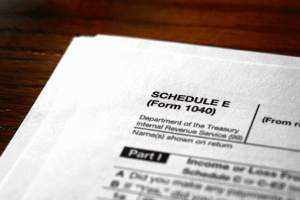 Accordingly, a rental activity is a passive activity even if you materially participated in that activity. The exception is if you materially participated as a real estate professional.
$25,000 Passive Activity Limitation
The passive activity limitation rules limit losses to $25,000. Consequently, adjusted gross incomes which are less than $100,000, can deduct losses up to $25,000. For incomes greater than $100,000 losses are phased out. The phase out is between $100,000 and $150,000. The suspended losses net against passive income in future years. In summary, these losses are tracked on IRS Form 8582. Notably, to qualify you have to meet the Active Participation standard.
Most short-term rental hosts shouldn’t be using Schedule E to report their short-term rental activity.
Summary
As noted, Airbnb or VRBO guests usually stay for less than 7 days. The Airbnb web site “paid out report” shows guest stays. You can use Excel or Google Sheets to calculate the average. Notably, the Airbnb website outputs the reports in “CSV” and “PDF” formats.
Many Airbnb Hosts use the wrong form.
All things considered, the appropriate individual filing tax form is schedule C. However, many tax filers report their short-term rental activity on Schedule E. Notably, this will lead to problems for short-term rental hosts. In other words, eventually they’ll receive deficiency letters.
Most importantly, the IRS has been so slow to adapt to the rapidly emerging peer-to-peer economy. Therefore, billions of dollars in taxable income go unreported, annually. A recent study delivered to Congress revealed how much is being under reported. However, the IRS is making changes. One such change is to change the filing requirements for form 1099-K.
86 Quick Books The Mess


What Are Substantial Services?
To determine whether you need to report on Schedule C or Schedule E, it’s important to understand what counts as substantial services. These services are typically those provided for the convenience of guests and are more like a hotel operation than a simple rental. Here are some examples:
-
Substantial Services (Schedule C):
-
Daily cleaning of the rental while occupied.
-
Providing meals, transportation, or guided excursions.
-
Offering concierge services.
-
-
Insubstantial Services (Schedule E):
-
General maintenance and cleaning between stays.
-
Providing heat, water, and Wi-Fi.
-
Taking care of trash collection and simple repairs.
-
If your services resemble those of a bed-and-breakfast or hotel, you are likely providing substantial services, requiring you to use Schedule C and pay self-employment tax.
How Personal Use Affects Your Deductions
If you use your property both for personal use and as a rental, you need to determine how much of your expenses are deductible. The IRS uses the vacation home rules to figure this out. Here’s a quick guide:
-
If you used the property for personal purposes for more than 14 days or more than 10% of the rental days, your deductible expenses may be limited.
-
Calculate the percentage of days that were used for rental versus personal use to allocate deductible expenses.
-
Personal use includes days when you or a relative used the property, even if no rent was paid.
Do Vacation Home Rules Apply?
-
Did you use the property for personal reasons?
-
Yes: Determine if the use exceeded 14 days or 10% of rental days. Apply the vacation home rules.
-
No: All related rental expenses may be deductible.
-
Passive vs. Non-Passive Income
Most Airbnb rentals are classified as non-passive activities due to the 7-day rule, meaning that if the average rental period is 7 days or less, the activity is considered non-passive. As a result, the rental income or losses can be offset against other types of income. Including wages!
If your property is a passive activity because you don’t meet the 7-day or 30-day rule (substantial services), you could still meet the active participation test. If you actively manage your rental—making key decisions like approving tenants or handling repairs—you may qualify for active participation, allowing you to deduct losses of up to $25,000 against non-passive income. However, this deduction starts to phase out when your modified adjusted gross income exceeds $100,000 and is completely phased out at $150,000.
Obviously, if you provide substantial services and are running the property like a business, the rental activity could also be considered non-passive, which makes it eligible for reporting on Schedule C.
Deductible Expenses for Your Airbnb
Understanding which expenses are deductible and how to allocate them between personal and rental use is key to reducing your taxable income.
-
Fully Deductible Expenses (Non-Personal Use Rentals):
-
Mortgage interest and property taxes.
-
Utilities, insurance, and maintenance costs.
-
-
Partially Deductible (Personal Use Rentals):
-
Deduct expenses based on the percentage of days the property was rented versus personal use.
-
-
Non-Taxable Rentals: When renting for 14 days or less, income may be non-taxable, and expenses cannot be deducted, except for mortgage interest and property taxes.
Real World Examples for Short-Term Rental Hosts
-
Schedule C Scenario: You rent out your property on Airbnb, providing breakfast each morning and offering concierge services. Since these are substantial services, you will report your income on Schedule C and be subject to self-employment tax.
-
Schedule E Scenario: You rent out a guest house on Airbnb where guests stay for more than 7 days but less than 30 days, without providing any additional services beyond basic maintenance and utilities. In this case, you report your rental income on Schedule E as passive income.
-
Non-Taxable Rental Scenario: You rent your vacation home for just 10 days during a year when you also used it for personal vacations. The rental income is non-taxable, and you cannot deduct rental-related expenses.
Airbnb Schedule C or Schedule E?
Sch C or E? If you’re wondering whether to use Schedule C or Schedule E for your short-term rental, the answer might surprise you—it’s often Schedule C. According to IRS Publication 925, an activity is not considered a rental activity if the average stay is less than 7 days. This distinction can have significant tax implications, affecting how losses are reported, property sales are treated, and whether you owe self-employment tax. For personalized advice, I recommend consulting a tax professional experienced in Airbnb and short-term rentals. Lucky for me I’m an expert.
Airbnb Schedule C, Days Rented or Available
When it comes to reporting your rental income, understanding the difference between “days rented” and “days available” is crucial, especially if you rent out part of your primary residence. Let’s break it down simply.
Days Rented: These are the days your property is actually occupied by a guest, meaning you’ve got a tenant and are earning rental income. It’s essentially the days when a lease or rental agreement is in effect. Days Available: This refers to all the days your property is open and ready to be rented, including both the days it is rented and those when it’s vacant but available. The distinction becomes important if you’re renting part of your primary home. If you live in the property, you typically report only the “days rented”.
On the other hand, if the property is used solely for rental purposes—like an investment or business property—you would use the “days available” for occupancy. Here’s an example to make it clearer: Suppose your property is available for rent for the whole month, but a guest only stays for 20 days. In that case, “days rented” is 20, and “days available” is 30. Tracking both “days rented” and “days available” can help you understand your occupancy rate, vacancy rate, and the overall performance of your rental. I know this can be a little tricky, but you don’t have to figure it all out on your own. As a CPA with a focus on short-term rentals, I’m here to help you navigate these details. Feel free to call me at 800-705-9968, and I’d be happy to explain further.
What are the Airbnb trade or business rules?
The IRS rules around Airbnb and rental properties feels overwhelming. However, understanding these basics can make a big difference.
Passive vs. Non-Passive Activities
The IRS classifies activities into three types: passive, non-passive, and portfolio income. Passive activities include rental real estate and other business activities where you do not materially participate. Non-passive activities involve businesses where you are actively engaged. Portfolio income includes interest, dividends, and certain capital gains. Understanding these categories is essential because they determine how you can use any losses from these activities for tax purposes.
Passive Activity Loss (PAL):
A passive activity loss happens when your expenses for a passive activity are greater than the income generated by that activity in a given tax year.
Material Participation:
This is a key concept in figuring out if an activity is passive or non-passive. If you meet certain tests for material participation, the activity is considered non-passive, meaning losses from that activity can be used to offset other income. Generally, Airbnb activities can meet the criteria for material participation, which may allow you to benefit from your rental expenses more easily. Deduction Limits: Passive losses can only be used to offset passive income. Any excess passive losses that can’t be used right away are carried forward to future tax years. It’s also important to know there are limitations on how much passive loss can be deducted against other income, like your ordinary income.
Real Estate Professionals:
If you qualify as a real estate professional (based on specific criteria for time spent in real estate activities), you can deduct passive losses related to rental real estate against your non-passive income. This is an exception under IRS Section 469(c)(7), which allows individuals who materially participate in rental real estate to treat those activities as non-passive. Active Participation in Rental Real Estate: The IRS also allows a limited deduction of up to $25,000 of passive losses from rental real estate if you actively participate in the rental and meet certain income thresholds. Keep in mind that this deduction phases out as your income increases.
These rules can be complex, and you don’t need to navigate them alone. If you have questions or need guidance specific to your situation, feel free to call me at 800-705-9968—I’m here to help!
What’s the difference between Schedule C and Schedule E for Airbnb rentals?
The distinction comes down to whether your Airbnb activity is treated as a business or a rental activity. If you’re providing significant services to your guests—similar to what a hotel would offer, such as daily cleaning or concierge services—you’ll need to report your income on Schedule C, which is used for businesses. On the other hand, if you’re only renting out space without substantial services, you’ll generally use Schedule E
When should I use Schedule C?
You should use Schedule C if:
- The average rental period is less than 7 days, or less than 30 days if you’re also providing substantial services like daily maid services, cooking, or guided tours.
- Your rental activity is more like an active business where you are heavily involved and offering services that are primarily for the guest’s convenience.
When should I use Schedule E?
Use Schedule E if:
- Your average rental period is longer than 7 days, and you do not provide substantial services.
- Your rental property is more passive in nature, where you’re mainly providing the space and basic amenities, such as clean linens between guest stays.
What is “substantial service,” and why does it matter?
The IRS uses the term “substantial services” to distinguish between passive and active rental activities. Substantial services go beyond providing a place to stay—they include services like breakfast, daily cleaning, or concierge services. If you provide these, you’re effectively operating a business, and income should be reported on Schedule C. Reporting income this way means it may also be subject to self-employment tax.
Are there any tax benefits to using Schedule C over Schedule E?
Reporting on Schedule C can sometimes be beneficial because you may be able to deduct a broader range of expenses and offset these against other income. However, this also means that you’re subject to self-employment tax, which may increase your overall tax liability compared to reporting on Schedule E.
What if I alternate between providing substantial services and only renting the property?
If your rental activity changes over time, for instance, sometimes providing substantial services and other times not, you may need to split your income and report part of it on Schedule C and part on Schedule E. It’s important to keep clear records of the services provided and the rental periods to accurately report this to the IRS.
Can I switch between Schedule E and Schedule C each year?
Yes, but this depends on the services you provided during the tax year. If the nature of your rental activity changes, your reporting requirements may change accordingly. Just keep in mind that consistency and documentation are key.
Airbnb Schedule C or E
Summary
|
|
Rental |
Business |
| Average rental period and services provided.[i] |
>7 days and no services or >30 days |
<7 days or <30 days and significant services |
| Tax implications if there are zero days of personal use of the rented space.[ii] |
Report on Schedule E Passive Subject to net investment income tax Not subject to self-employment tax |
Report on Schedule C Not passive Not subject to investment income tax Subject to self-employment tax |
| Tax implications if there is at least one day of personal use. [iii] | Indirect expenses must be allocated between rental and personal days.[iv] | Indirect expenses must be allocated between rental and personal days. |
| Tax implications if personal use of dwelling unit exceeds 14 days and 10% of rental days. |
No loss is allowed, expenses must be deducted in specific order,[i] excess carries forward. Not passive. |
No loss is allowed. The expenses must be deducted in specific order and the excess carries forward. |
[i] Significant services are those provided for the convenience of the occupant, such as room cleaning, linen service, meals, and laundry. “No services” implies that guest provide their own sheets and towels.
[ii] Personal use includes use by any member of the taxpayer’s family, as well as days the property is rented for less than fair rental value.
[iii] Dwelling is a residence if taxpayer’s personal use exceeds 14 days and 10% of the rental days.
[iv] Typically, square feet occupied by rental space divided by total square feet in the residence.
[v] Direct expenses and allocated portion of mortgage interest and property taxes first, and allocated indirect expenses other than cost recovery next, cost recovery last. Any amount of residence interest or property tax not deducted as a rental or business expense is deductible in itemized deductions, subject to limitations based upon amount of acquisition indebtedness and the $10,000 limit on state and local deductions.

Other Considerations
Joint Venture or Partnership?
Joint Venture
Generally, you can elect to file as a joint venture. However, you and your spouse must own the short-term rental property. In other words, both schedule C and E allow for you to elect to file as a joint venture.
 Partnership US 1065 Tax Return
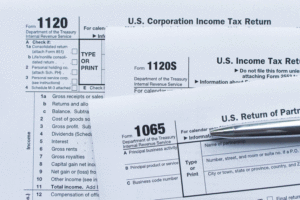
Most importantly, two spouses who own an LLC together requires the filing of a US partnership tax return. Notably, this is in the 1065 instructions. However, you can elect not to file a US partnership 1065 tax return, if you agree to calculate self employment or fica taxes as if you were in a partnership.
- However, nine community property states don’t consider the LLC a partnership. The nine U.S. states that have community property laws in place are Arizona, California, Idaho, Louisiana, Nevada, New Mexico, Texas, Washington, and Wisconsin.
Above all, two individuals owning or sharing in the profits of a short-term rental activity are required to file a US partnership tax return. The partners receive K-1’s to file their individual income taxes. In conclusion, many cohost arrangements are deemed partnerships.
The Round Robin Short-Term Rental Tax Strategy
For Holistic Tax Planning
Short-Term rental Hosts who want to maximize taxes.
The Round Robin Strategy allows short-term rental hosts to maximize tax savings by periodically moving into their rental properties. When you reside in a property used for short-term rentals, you can allocate expenses and usage between business and personal. It’s essential to prorate the time spent and space used for business versus personal purposes to comply with tax requirements.
Most importantly, this strategy helps you qualify for the residence exclusion, which can mean significant tax savings. For single taxpayers, the exclusion allows up to $250,000 in tax-free gains, while married couples filing jointly can exclude up to $500,000. To qualify, you need to live in the home for at least 2 of the last 5 years. This $500,000 exclusion could translate into $100,000 or more in permanent tax savings, making it a highly beneficial approach.
Many short-term rental hosts miss out on this valuable tax deduction by not planning ahead. Using the Round Robin Strategy can help you reduce your tax burden and keep more of your hard-earned gains.
- If you are using a residence you used to occupy, I recommend you schedule a free consultation.
1099-K $5,000 limit for 2024?
- Starting in 2024, taxpayers receiving payments through a third-party processor will get a 1099-K form once their transactions reach $5,000. This phase-in gradually introduces the lower $600 reporting threshold established by the American Rescue Plan. By implementing this new limit, the IRS aims to increase transparency for income earned through payment processors.
- Many taxpayers could unintentionally exceed the new IRS threshold just by selling items at a garage sale, reselling old college textbooks online, or using payment apps to send money to friends and family. Even though selling used personal items for less than you originally paid or reimbursing friends for concert tickets aren’t taxable events, taxpayers might still receive a 1099-K form at year’s end. This can easily mislead people into thinking they owe taxes on these transactions.
Moreover, taxpayers may lack proper records to demonstrate to the IRS that these payments are non-taxable. Without clear substantiation, individuals may end up paying taxes on cash transfers that aren’t truly income. For instance, if someone frequently pays family members back using cash apps, or sells personal items without keeping receipts, they risk incurring unnecessary tax liabilities.
- Many taxpayers could unintentionally exceed the new IRS threshold just by selling items at a garage sale, reselling old college textbooks online, or using payment apps to send money to friends and family. Even though selling used personal items for less than you originally paid or reimbursing friends for concert tickets aren’t taxable events, taxpayers might still receive a 1099-K form at year’s end. This can easily mislead people into thinking they owe taxes on these transactions.


Free Simple Rental Property Forecast Excel Workbook
Simple forecast. Primarily, 30/15 yr conventional mortgage financing.
Details


Special Offer!
Free Complimentary QuickBooks Setup and Consultation



Why choose an LLC?
A popular form of doing business.
Airbnb tax advice
Minimize, reduce short term rental income taxes. Professional Airbnb CPA tax advice
Maximize Your Short Term Rental Investment
Unlock tremendous benefits. Undoubtedly, a cost segregation study (CSS) is a tax strategy tool used by short-term rental hosts to accelerate depreciation. If your schedule C net income is negative, it will offset other active income.

Most importantly, wages and income from other businesses are active income.

Located in the Galleria Mall, Fort Lauderdale
Schedule a time to visit us / Go to your Office.Convenient Location

David Weinstein MBA CPA CFE
Contact Us
For inquiries or requests which require a more personal response, I will make every attempt to respond.